Solar Panel Sizes Explained: What you need to know.
Solar Panel Sizes Explained: What Size Do You Need?
Introduction (Straight to the Point)
If you’ve ever installed solar at home in Nigeria, you’ll know one truth very quickly: panel size can make or break your entire system. I’ve seen homes with many panels still struggling, and others with fewer panels enjoying steady power. The difference is not luck — it’s choosing the right solar panel size.
For Nigerian homes, guessing panel size leads to wasted effort, weak performance, and frustration. This guide explains solar panel sizes in Nigeria in simple terms, so you can confidently decide what size solar panel you need for your home. I’ll also share practical tips from my own experience in Lagos and other Nigerian cities.
What “Solar Panel Size” Really Means
When Nigerians hear “solar panel size,” many people think it only refers to the physical size. In reality, it means three important things working together:
Panel Wattage
This refers to how much power a panel can produce under good sunlight. Higher wattage means more electricity from one panel. For instance, a 350W panel produces more energy than a 250W panel over the same hours of sunlight.
Physical Size
Panels with higher wattage are usually physically bigger. This affects how many panels your roof can comfortably carry. A small roof may not fit many panels, so wattage per panel becomes critical.
Power Output Over Time
Panel size also affects how much energy you get during the day, how fast your batteries charge, and how stable your home solar system in Nigeria feels. Consistency is important, especially during long power outages.
Key Factors That Determine the Right Solar Panel Size
Daily Electricity Usage in Nigerian Homes
This is the most important factor. Think about what you use every day, not occasionally.
- Lighting
- Fans
- Television
- Decoder
- Refrigerator
- Phone and laptop charging
- Water pump (if applicable)
- Small kitchen appliances
Homes that run multiple appliances simultaneously will need larger total panel wattage. For example, a bungalow in Ibadan using fans, fridge, TV, and lighting requires fewer panels than a duplex in Lagos running water pumps and multiple TVs.
Roof Space and Layout
Your roof limits how many panels you can install. Consider the roof size, shape, strength, and available open space. Flat roofs give more flexibility in orientation, while sloped roofs may limit panel arrangement.
Sunlight Availability
Panels placed where sunlight is steady will always perform better. Northern Nigerian homes often get more sun hours than southern coastal regions, so panel numbers and wattage may differ based on location.
Panel Efficiency
The type of panel (monocrystalline or polycrystalline) affects output. Efficient panels produce more energy in less space, which matters for homes with limited rooftop area.
How to Calculate the Right Solar Panel Size for Your Home
Step-by-Step Guide
- Determine daily electricity consumption in kWh. Example: Lights (2kWh) + Fans (3kWh) + Fridge (2.5kWh) + TV (1kWh) = 8.5 kWh/day.
- Check average peak sun hours per day for your location. Example: Lagos averages 5 peak sun hours/day.
- Calculate required panel wattage: Total kWh ÷ Peak sun hours = Required kW. Example: 8.5 ÷ 5 = 1.7 kW.
- Convert kW to W: 1.7 kW = 1,700W. Decide number of panels: If each panel is 350W → 1,700 ÷ 350 ≈ 5 panels.
- Adjust for losses (battery, inverter, shading): Add 20% → 5 × 1.2 = 6 panels recommended.
Diagram: How Solar Panel Size Matches Home Energy Needs
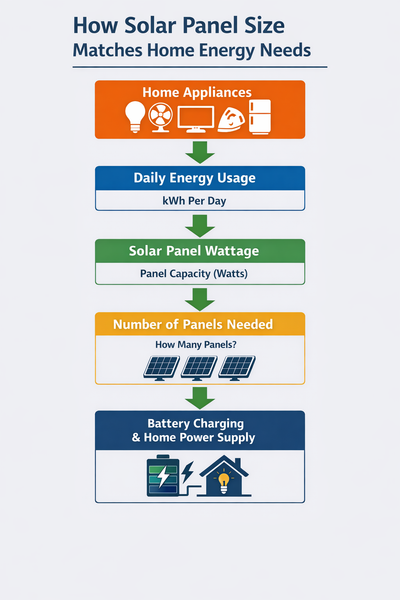
The diagram shows the flow: Home Appliances → Daily Energy Usage → Required Panel Wattage → Number of Panels → Battery Charging & Home Power Supply. It makes sizing much easier to visualize.
Solar Panel Size Guidelines for Common Nigerian Homes
Small Apartments
Suitable for lighting, fans, television, and charging devices. Typically need 1–3 panels depending on roof space and appliance use.
Medium-Sized Family Homes
Run refrigerators, multiple TVs, fans, and lighting. Usually require 4–6 panels, depending on wattage and sun availability.
Larger Homes
Often use water pumps, multiple fridges, and higher simultaneous loads. 6+ panels may be needed for reliable performance.
How Panel Size Affects System Performance
Daytime Usage
Correct panel sizing ensures appliances run during the day without draining batteries unnecessarily.
Battery Charging
Panels must provide enough energy to fully charge batteries for nighttime use. Undersized panels lead to low nighttime power.
Expansion Planning
Choosing slightly higher wattage than current needs allows future expansion without replacing the system.
Choosing the Right Panel Size Without Guessing
- Assess daily kWh usage carefully.
- Check your roof dimensions and sunlight exposure.
- Plan for 1–2 panels extra if you might add appliances later.
- Avoid random guesses or copying neighbors’ setups.
Common Mistakes Nigerians Make When Sizing Panels
- Buying too few panels for actual consumption.
- Ignoring roof shading or tilt, leading to wasted output.
- Not factoring in inverter and battery losses.
- Failing to plan for future appliance additions.
Related Guides
How to Choose the Right Solar Panel for Your Home in Nigeria
Cost of Solar Installation in Nigeria
Frequently Asked Questions (FAQs)
- What size solar panel do I need for a small apartment in Nigeria? Generally 1–3 panels, depending on appliances and sun hours.
- Can I calculate panel size myself? Yes, using daily kWh usage divided by peak sun hours and factoring in system losses.
- Does roof orientation matter? Yes. Panels facing direct sunlight perform best; shaded areas reduce efficiency.
- How many panels for medium-sized family homes? Typically 4–6 panels, but exact number depends on energy usage and roof space.
- Should I oversize panels for future use? Adding 1–2 extra panels is recommended if you plan to add appliances later.
Final Conclusion
Choosing the correct solar panel size for your Nigerian home is critical for reliable, stress-free solar power. By understanding your daily energy needs, roof space, and sunlight availability, you can select the right number of panels that fit your lifestyle. Proper planning prevents underperformance and ensures your home solar system in Nigeria works efficiently for years to come.
Comments
Post a Comment
We’d love to hear your opinion. Please leave a comment to join the discussion.